



Come on in! I'll tell you about Ireland!
(Click photos to see them larger)
Dave and I spent April of 2003 in
Ireland. How was it, you ask? Well, it was pretty darn cool!
We flew into Dublin (Portland to Frankfurt direct on Lufthansa, 10 hour flight,
ugh) and spent several days there. We had a great time seeing things we
missed last time, and recognizing places from our earlier visit. We visited
the Guinness brewery, and the Jameson whiskey distillery 
 .
We also saw many interesting things in the streets of Dublin. Here's a
photo of the keg truck
.
We also saw many interesting things in the streets of Dublin. Here's a
photo of the keg truck  .
This truck is one of many that travels the streets of towns and villages all
over Ireland every morning, picking up the empty kegs from the night
before. The pubs just leave the empties out on the curb. We also saw
this judge outside Ireland's Supreme Court building, nice powdered wig!
.
This truck is one of many that travels the streets of towns and villages all
over Ireland every morning, picking up the empty kegs from the night
before. The pubs just leave the empties out on the curb. We also saw
this judge outside Ireland's Supreme Court building, nice powdered wig! 
We also visited Kilmainham Gaol (jail).  It hasn't been used for years, but during its time it housed not only political
prisoners (people who wanted the English out of Ireland) but also children--some
as young as five! After going to jail, we went to church...we visited St.
Patrick's
It hasn't been used for years, but during its time it housed not only political
prisoners (people who wanted the English out of Ireland) but also children--some
as young as five! After going to jail, we went to church...we visited St.
Patrick's  ,
which was quite impressive. We also saw this in the window of a local
butcher shop, which was not quite so impressive
,
which was quite impressive. We also saw this in the window of a local
butcher shop, which was not quite so impressive  .
I wonder how one should prepare snout?
.
I wonder how one should prepare snout?
After we picked up our rental car, we headed
north of Dublin to Newgrange  .
Newgrange is a 5000 year old passage tomb. It is possibly the oldest
man-made structure in the world, it's older than Stonehenge and the
Pyramids. It's huge, covering one acre on the top of a hill and containing
200,000 TONS of dirt and rock. There is a tunnel--or passage--that goes 62
feet into the middle of the mound and at the end of the tunnel is a 20 foot tall
chamber. The tour allows you to go down the very narrow tunnel and into
the chamber, which is still water-tight after 5000 years--a tribute to the
"primitive" engineering skills of our Neolithic ancestors. The
tomb eventually fell into disrepair. The white stone walls around the
outside collapsed, and the tomb blended into the top of the hill. The
passage wasn't re-discovered until 1699. It was extensively restored to
its previous grandeur, including the precise reconstruction of the white stone
walls, in the 1960's.
.
Newgrange is a 5000 year old passage tomb. It is possibly the oldest
man-made structure in the world, it's older than Stonehenge and the
Pyramids. It's huge, covering one acre on the top of a hill and containing
200,000 TONS of dirt and rock. There is a tunnel--or passage--that goes 62
feet into the middle of the mound and at the end of the tunnel is a 20 foot tall
chamber. The tour allows you to go down the very narrow tunnel and into
the chamber, which is still water-tight after 5000 years--a tribute to the
"primitive" engineering skills of our Neolithic ancestors. The
tomb eventually fell into disrepair. The white stone walls around the
outside collapsed, and the tomb blended into the top of the hill. The
passage wasn't re-discovered until 1699. It was extensively restored to
its previous grandeur, including the precise reconstruction of the white stone
walls, in the 1960's.
It is thought
that Newgrange was built to hold human remains (possibly cremated). What
would have possessed ancient people to invest years (scientists estimate it took
a minimum of 70 years to build) and back-breaking labor into building this
structure? The outside of the mound is ringed with 55 large stones, all
weighing in excess of one ton. Scientists (again) estimate it took 80 men
4 days to move EACH stone from where it was quarried 10km away. And this
from people with an average lifespan of only 30 years!
Many of the 55 stones are finely carved, including the entrance stone shown here
 .
Here's us
.
Here's us  by the stone. There's a pretty interesting feature of Newgrange. Do
you see the stone rectangular box above the door? It is positioned so that
the light from the rising sun of the winter solstice passes through the box and
illuminates the inner chamber. The winter solstice is the only time of the
year that that happens. How amazing is that?
by the stone. There's a pretty interesting feature of Newgrange. Do
you see the stone rectangular box above the door? It is positioned so that
the light from the rising sun of the winter solstice passes through the box and
illuminates the inner chamber. The winter solstice is the only time of the
year that that happens. How amazing is that?
After Newgrange, we drove west across the country to the city of Galway.
Galway is a lovely place, built around a river and its various channels. 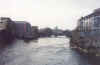 It's a college town, and has some great nightlife. It is also home to an area
known as the Claddagh
It's a college town, and has some great nightlife. It is also home to an area
known as the Claddagh  .
This was a fishing village in the olden days, home to a fiercely independent
people. It is also credited with being the birthplace of the creator of
the Claddagh, which is one of Ireland's most famous
symbols.
.
This was a fishing village in the olden days, home to a fiercely independent
people. It is also credited with being the birthplace of the creator of
the Claddagh, which is one of Ireland's most famous
symbols.
After Galway we headed
south to the village of Doolin, a famous center for traditional music. In
addition to enjoying some fine music, and mourning the loss of the patriarch of
Doolin's traditional music scene, Gus O'Connor, we also visited the Cliffs of
Moher. We visited the Cliffs on our honeymoon, but they're worth a second
look  .
.
From there, we went to our home away from home, our cottage  "Oceanview House". The oceanview was in the backyard, as you can
see in this photo of our closest neighbors,
"Oceanview House". The oceanview was in the backyard, as you can
see in this photo of our closest neighbors,  the cows that lived in the field behind the cottage. Our day wasn't complete until we'd had a visit from
them
the cows that lived in the field behind the cottage. Our day wasn't complete until we'd had a visit from
them  .
.
The cottage was located on the
Dingle Peninsula in County Kerry, in the southwest of Ireland. We were 15 miles from the town of Tralee,
which has about 25,000
people. We were one mile from the village of Castlegregory, which has
about 100 people. Castlegregory is famous (in Ireland) for its
beaches. Here's one of them 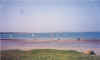 .
There's a windsurfing school at this beach. The entire Dingle peninsula is
home to 10,000 people...and a half million sheep!
.
There's a windsurfing school at this beach. The entire Dingle peninsula is
home to 10,000 people...and a half million sheep!
While we were staying at the cottage, we visited a lot of other towns and sights
all around the southwest of Ireland. Ireland is a small country, so things
are close. However, Irish roads leave a bit to be desired, so just because
something is close, that doesn't always mean you can be there soon!
One town we visited was Cork, in the south of Ireland, which is Ireland's second
largest town with 150,000 people (Dublin has about a million). Cork is
built around a river, and the downtown is actually on an island in the
river. We loved Cork because of this:  .
This is the "Thirsty Scholar" (it's across from the university), which
is our favorite pub. And it's our favorite pub because of this:
.
This is the "Thirsty Scholar" (it's across from the university), which
is our favorite pub. And it's our favorite pub because of this:  .
Potbelly Folk, which is our favorite traditional music group. They are the
best! We heard them twice, and found ourselves drinking Guinness and
singing the traditional favorites along with the locals. It was the kind
of night every tourist in Ireland dreams of having. We chatted we them
after one of the sessions, and got a copy of their CD. It was an experience
to remember.
.
Potbelly Folk, which is our favorite traditional music group. They are the
best! We heard them twice, and found ourselves drinking Guinness and
singing the traditional favorites along with the locals. It was the kind
of night every tourist in Ireland dreams of having. We chatted we them
after one of the sessions, and got a copy of their CD. It was an experience
to remember.
While in Cork we also saw a car
being towed  .
They have to do it a bit differently than we do here, because the streets are so
narrow. It was quite interesting!
.
They have to do it a bit differently than we do here, because the streets are so
narrow. It was quite interesting!
We
went to a horse race in Ireland, in a town just north of Cork. The Irish
take their horseracing very seriously. There is a ritual to the entire
event, from the pre-race parade, to the bet placing, to the race, to the
post-race parade. The race itself may last just a minute or two, but the
ritual of each race lasts a half hour. We bet on a horse named Giles  ,
but he didn't win. We also bet on a horse named Lendl during a
steeplechase race, which includes jumps. His jockey fell off over one of
the jumps, which isn't uncommon, but Lendl kept running and finished
second! We also bet on Mr. Dance A Lot, but he had a slow start and never
quite recovered. It was a fascinating day.
,
but he didn't win. We also bet on a horse named Lendl during a
steeplechase race, which includes jumps. His jockey fell off over one of
the jumps, which isn't uncommon, but Lendl kept running and finished
second! We also bet on Mr. Dance A Lot, but he had a slow start and never
quite recovered. It was a fascinating day.
Southwest of Cork city, we visited an old English fort called Charles
Fort. Charles Fort is a star fort, so called because it is laid out
roughly in the shape of a star 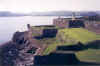 .
It commands a formidable position on an ocean inlet
.
It commands a formidable position on an ocean inlet  near the town of Kinsale. A symbol of English repression for several centuries,
it was abandoned when the English finally left Ireland in the
1920's. Now the Irish government is slowly restoring it, and it's a really
great place to visit. You can explore the entire place, scrambling up
bastions and battlements, peering out of lookout towers, and poking around
buildings still formidable despite decades of decay
near the town of Kinsale. A symbol of English repression for several centuries,
it was abandoned when the English finally left Ireland in the
1920's. Now the Irish government is slowly restoring it, and it's a really
great place to visit. You can explore the entire place, scrambling up
bastions and battlements, peering out of lookout towers, and poking around
buildings still formidable despite decades of decay  .
.
While in the southwest of Ireland, we visited
the most southwesterly point of the country. It is a windswept point of
land known as Mizen Head. There is a lighthouse there by the same name  .
Mizen Head is an interesting journey. The drive is an adventure, and then
if you want to visit the lighthouse, you have to cross this footbridge
.
Mizen Head is an interesting journey. The drive is an adventure, and then
if you want to visit the lighthouse, you have to cross this footbridge  ,
which spans a 150 foot deep ravine over the ocean. Keep in mind that this
includes a wind almost strong enough to push you sideways. Fun!
Happily, we lived to tell.
,
which spans a 150 foot deep ravine over the ocean. Keep in mind that this
includes a wind almost strong enough to push you sideways. Fun!
Happily, we lived to tell.
We visited the town
of Killarney several times. My great-grandmother Mary Ryan left Killarney
in 1909 for New York. Not much remains of the town she would have known,
for Killarney is a tourist mecca, and has been built into something that
Americans would recognize as Irish, but isn't really so. It has a Holiday
Inn, for goodness sake! But, it is also in an area of incredible natural
beauty, and those who leave the outlet mall will be well rewarded.
Killarney is set on three lakes, and in the middle of one of the lakes is an
island called Innisfallen. Innisfallen island contains the remains of a
6th century abbey.  To get to Innisfallen, you hire a rowboat from Ross Castle (which is pretty cool
itself). Once on the island, you wander around, admiring the ruins.
Dave and I were lucky enough to have the entire island to ourselves, and we had
a great time exploring the whole place.
To get to Innisfallen, you hire a rowboat from Ross Castle (which is pretty cool
itself). Once on the island, you wander around, admiring the ruins.
Dave and I were lucky enough to have the entire island to ourselves, and we had
a great time exploring the whole place.
We
visited some more ruins later on, an abandoned village called Killelton.
The inhabitants were evicted by the (English) landlord after the famine, which
was an extremely common and horrible practice during that time. There are
many ruins of homes in Ireland, grim reminders of the hardships this island has
endured, but to see an entire village abandoned and in ruins was quite sobering.
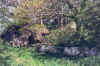
 In addition to the homes, it also contains the ruins of a church. The
village used to be on the main road into the Dingle peninsula, and was only a
few miles from our cottage. No roads go to Killelton now, it's a hike of
about a mile. Here's a photo from the hike
In addition to the homes, it also contains the ruins of a church. The
village used to be on the main road into the Dingle peninsula, and was only a
few miles from our cottage. No roads go to Killelton now, it's a hike of
about a mile. Here's a photo from the hike  .
.
We explored the entire Dingle peninsula, which is a really great corner of the
world. The peninsula has the highest concentration of archaeological
remains in Ireland, partially because the landscape provides a difficult
existence for the few people brave enough to try. Ringed by the ocean, and
crossed by rocky mountains, the Dingle peninsula doesn't make it easy. But
it hides wonderful treasures among the hillsides and in villages where Irish is
still spoken. The westernmost point in Europe, we enjoyed a lovely lunch
at Kroger's, which is the westernmost pub. They even have a jovial pub
dog, who really wanted a bite of Dave's sandwich!  Just down the road, we captured this lovely view
  .
The near gale-force winds in this area are a part of everyday life.
.
The near gale-force winds in this area are a part of everyday life.
One of our last adventures in the countryside was a visit to Cahir Castle.
This castle is the best preserved in Ireland, with its outer wall completely
intact, which is very rare since the English bashed most of them in. The
castle's excellent condition has nabbed it some parts in several movies. 
 .
But, although it was built to last, it was not built for tall people! The
Irish were, apparently, a short folk. Here's Dave navigating the interior
of the castle
.
But, although it was built to last, it was not built for tall people! The
Irish were, apparently, a short folk. Here's Dave navigating the interior
of the castle  .
At least this one carried a warning...
.
At least this one carried a warning... 
We spent the last couple of days in Dublin, and had a great time. We were
able to go to a soccer game, the Irish national team vs. Norway in the early
playoffs for the European cup.  It was quite the experience, with singing and chanting and general
hooligan-ism. Happily Ireland won, so we didn't have to contend with any
riots.
It was quite the experience, with singing and chanting and general
hooligan-ism. Happily Ireland won, so we didn't have to contend with any
riots.
We also visited Malahide castle, just
north of Dublin.  Many of the castles you tour in Ireland aren't furnished, but this castle was
lived in until the 1970's and is fully furnished with beautiful antiques and
paintings from the National Gallery. The same family owned and occupied
the castle since its building in the 1600's, which is rare in Ireland, with all
the "troubles". The family donated the castle to the state in
the 70's and retired to their lands in Australia. Rough!
Many of the castles you tour in Ireland aren't furnished, but this castle was
lived in until the 1970's and is fully furnished with beautiful antiques and
paintings from the National Gallery. The same family owned and occupied
the castle since its building in the 1600's, which is rare in Ireland, with all
the "troubles". The family donated the castle to the state in
the 70's and retired to their lands in Australia. Rough!
And lastly, what would a trip to Dublin be without visiting a U2 sight?
This is a photo of Windmill Lane, which is a street that U2 fans have decorated for the greatest band of all
time. Fans from all over the world visit here and write messages for the
rock gods of Dublin.
which is a street that U2 fans have decorated for the greatest band of all
time. Fans from all over the world visit here and write messages for the
rock gods of Dublin.
And aside from meeting a one-eyed cat named
Lucky, that's about it!

Signing
off from Ireland, until next time!


